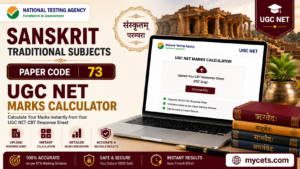
Free UGC NET Sanskrit marks calculator. Upload your response sheet and get your score instantly against the official answer key.
UGC NET Sanskrit Marks Calculator: Skip the Manual Cross-Checking
Sanskrit draws a large candidate pool every UGC NET cycle, and its Paper 2 spans grammar (Vyakarana), classical literature (Kavya), Vedic texts, philosophy (Darshana), and poetics — enough range that manually matching 100 questions against the answer key is genuinely time-consuming. Upload your response sheet below instead.
UGC NET 2026 Answer Key Calculator
Upload your official response sheet. It's checked against the released answer key right in your browser — nothing is uploaded anywhere.
| # | Question ID | Your Answer | Correct Answer | Result |
|---|
How to Get Your Score
- Log in at ugcnet.nta.nic.in and download your Sanskrit (subject code 25) response sheet once released
- Upload the PDF to the calculator above
- Click Analyze — your score, a correct/wrong/unattempted breakdown, and a full question-wise table appear instantly
How UGC NET Marks Are Calculated
Total Marks = (Correct in Paper 1 × 2) + (Correct in Paper 2 × 2)
- Correct answer: +2 marks
- Wrong answer: 0 marks — no negative marking
- Question dropped after review: full marks awarded to everyone who attempted it
Sanskrit Paper 2 typically runs 100 questions worth 200 marks, added to Paper 1’s 100 marks, for 300 total.
Where Manual Counting Goes Wrong in Sanskrit
Sanskrit Paper 2 alternates between grammar-based questions (Vyakarana rules), classical Kavya literature, Vedic texts, and the six Darshanas (philosophical schools) — genuinely different question styles that don’t always appear in a predictable order. It’s easy to lose your row alignment moving between a grammar-rule question and a Darshana question while counting by hand. This calculator matches every answer by its actual Question ID, so switching between these areas never causes a miscount.
Downloading Your Response Sheet and Key
- Visit ugcnet.nta.nic.in
- Open the “Question Papers, Recorded Responses and Answer Key” section once live
- Log in with your Application Number, DOB or password, and the security PIN
- Download your question paper, response sheet, and provisional key — save all three promptly, as access typically closes within 2–3 days
Objecting to the Sanskrit Answer Key
- 4-day window from the day the provisional key is published
- ₹200 per question, non-refundable, paid via card, net banking, or UPI
- Cite a standard grammar treatise, classical text, or established commentary to support your challenge
- Only the provisional key accepts objections — the final key does not
Qualifying Marks
- General category: 40% aggregate across both papers
- Reserved categories: 35% aggregate
- JRF: typically higher, and announced subject-wise with the final result
What UGC NET Sanskrit Covers
Meant for candidates with a postgraduate degree in Sanskrit, Paper 2 typically spans Sanskrit grammar (Vyakarana), classical Sanskrit literature (Kavya), Vedic literature, the six schools of Indian philosophy (Darshana), and poetics (Alankara Shastra). Check the official syllabus PDF for this session’s exact unit weightage.
FAQs
Q: How do I calculate my UGC NET Sanskrit marks?
Upload your response sheet PDF to the calculator above — it checks every answer against the official key and shows your score instantly.
Q: Is the calculator free?
Yes, completely free, with no login or signup.
Q: Is there negative marking in UGC NET Sanskrit?
No, wrong answers score zero.
Q: What’s the minimum qualifying score?
40% aggregate for General category, 35% for Reserved categories, across both papers.